Learning for Life is an innovative, evidence-based program that supports students throughout their education to achieve positive long-term outcomes for young people experiencing disadvantage.
Our work engages Aboriginal and Torres Strait Islander communities in learning through education, life skills and role models, promoting culturally responsive practice.
Our learning support and mentoring programs in 90 Australian communities directly help children in need achieve their goals through education.
Corporate partnerships give young Australians in need the chance to change their futures through educational support. Discover how you can join forces with The Smith Family to create a mutually-beneficial, impactful partnership.
Making small, regular donations to The Smith Family through Workplace Giving is an easy way to help change the lives of young Australians living in poverty.
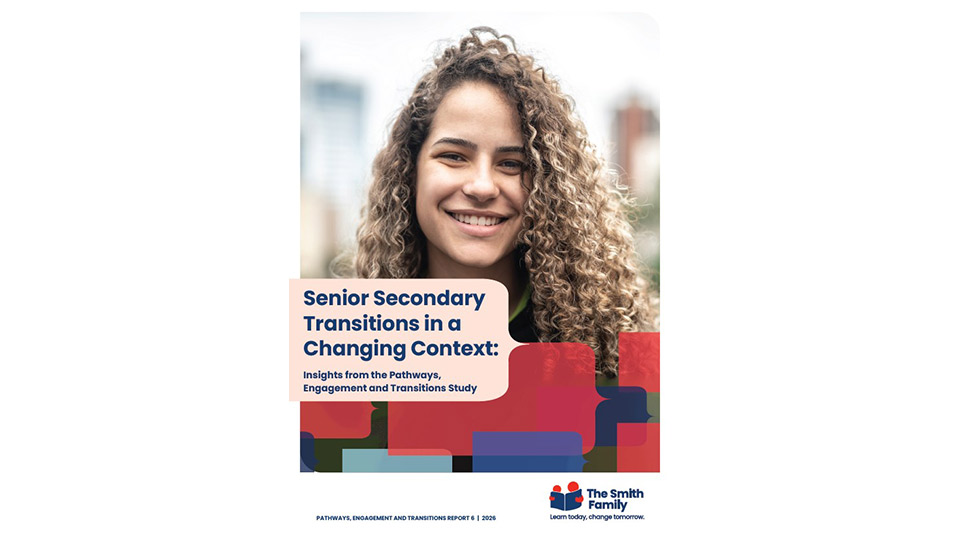
Pathways, Engagement and Transitions: Senior Secondary Transitions in a Changing Context
The Pathways, Engagement, and Transitions (PET) study focuses on the experiences of young people growing up with disadvantage. This report, Senior Secondary Transitions in a Changing Context, is the sixth in the series and is a longitudinal study of two cohorts of young people who were in Year 10 in 2020 and Year 10 in 2023. It follows them for two years after Year 10 and provides a unique opportunity to understand how the different schooling and economic contexts experienced by each cohort are shaping their senior secondary pathways and post-school decisions. All outcomes are measured in March-May approximately 18 months after the end of Year 10 (and before the conclusion of Year 12).
More of the Year 10 2023 cohort (18%) left school before Year 12 than the Year 10 2020 cohort (14%)
Fewer early school leavers from the Year 10 2023 cohort (17%) were employed full time than the Year 10 2020 cohort (27%)
Fewer early school leavers in the Year 10 2023 cohort (54%) were engaged in work or study than the Year 10 2020 cohort (64%).
Young people in the Year 10 2023 cohort were leaving school earlier than the Year 10 2020 cohort
The proportion of young people leaving school before Year 12 was higher among the 2023 cohort (18 percent) than the 2020 cohort (14 percent). The increase was particularly evident for students leaving at the end of Year 10 or during Year 11, while the proportion leaving after completing Year 11 was similar across both groups. Understanding whether the proportion of young people completing Year 12 has changed between the cohorts will only be possible when 2026 survey data is available (i.e. the first year post-Year 12 for the 2023 cohort). It is possible that similar proportions of young people in each cohort left school before completing Year 12, but that the 2023 cohort made the decision to leave earlier in their school progression.
For those continuing at school, post-school intentions were the same for each cohort
When young people were in Year 11, similarly high proportions in each cohort intended to complete Year 12 (97 percent for the 2020 cohort, and 99 percent for the 2023 cohort). Among those who continued to Year 12, their post-school plans for university, TAFE, and work were also broadly consistent.
Early school leavers in the 2023 cohort had worse employment outcomes
The most substantial differences emerged in early post-school outcomes for early school leavers, where young people in the 2023 cohort had significantly worse employment outcomes than those in the 2020 cohort. The younger cohort was less likely to be employed full time (2020 cohort: 27 percent; 2023 cohort: 17 percent), more likely to be unemployed (2020: 41 percent; 2023: 53 percent), and those in the younger cohort who were employed worked fewer hours on average. The share of early school leavers not engaged in either work or study increased markedly—from 36% to 47% in just three years—with the sharpest rises among young males.
These changing employment outcomes reflect broader structural trends affecting youth employment, including declining availability of and heightened competition for lower skilled, entry level jobs, and rising precarity in youth dominated industries.
Policy implications
With the proliferation of generative AI, the next generation of students navigating secondary school are facing a different set of disruptions to their learning experience and post-school labour markets. The impacts will likely heighten the economic and social vulnerability of young people experiencing disadvantage, and providing more targeted skill development and career support while they are still engaged at school will help them to prepare for uncertain futures.
Previous research and the findings of this study highlight several opportunities for improving outcomes for young people experiencing disadvantage:
Strengthen early identification and support in the early secondary school years to prevent later disengagement and early school leaving.
Enhance career education and postschool planning, beginning earlier and offering exposure to diverse pathways, vocational options, and emerging industries.
Boost digital literacy and foundational skills, which are increasingly critical for both education and employment.
Provide holistic, tailored supports for early school leavers, including job readiness training, mental health supports, mentoring, and flexible reengagement pathways.
Address structural labour market barriers, including reduced entry level opportunities and emerging risks associated with automation and generative AI.
Conclusion
Overall, this study shows that while senior secondary aspirations remain consistently high, differences in earlier schooling experiences and labour market conditions have affected the senior secondary and post-school transition pathways for young people experiencing disadvantage. Early school leavers are particularly vulnerable to worsening labour market conditions and require targeted, coordinated support to secure stable, meaningful pathways as they move into early adulthood.
Recommendations
For schools:
Strengthen early identification and support. Use available data resources (e.g. attendance, engagement, and achievement data) to identify students at risk of disengagement in the early secondary years, and provide sustained, personalised supports before students disengage more deeply.
Enhance career education and post-school planning earlier. Deliver earlier, higher quality career guidance that exposes students to diverse pathways, including vocational options and emerging industries, alongside one-to-one support for navigating decisions and applications.
Embed work-relevant skills and experiences. Provide structured opportunities for students to build foundational, digital, and employability skills, including real-world learning and exposure to workplaces.
For government:
Enable earlier, coordinated intervention. Strengthen system-level approaches to early identification by improving data sharing, and access to integrated supports spanning education, health, and social services.
Invest in sustained and targeted supports. Fund programs that provide intensive, personalised support through the early secondary years and into transitions, recognising the cumulative impacts of disadvantage and disruption.
Respond to structural labour market change. Expand pathways aligned to emerging industries, address declining entry-level opportunities, and ensure policy settings support secure, accessible roles for young people with limited experience or qualifications.
Support inclusive and supportive workplaces. Adopt employment practices that recognise the needs of young workers, including flexibility, supervision, and development opportunities that enable them to enter and remain in the workforce.
For businesses and employers:
Create accessible entry-level opportunities. Increase the availability of secure, supported entry-level roles for
young people, particularly those with limited experience
Strengthen partnerships with schools and communities. Collaborate with schools and community organisations to provide work exposure, mentoring, and pathways into employment, particularly for disadvantaged young people.