Our learning programs
One in six Australian children are currently living with poverty1.
Living in poverty can impact a child’s opportunities and future outcomes. Poverty often means fewer educational resources, limited access to support, and challenges that can span generations, creating barriers that prevent children from fully benefiting from their learning. Poverty also places barriers in the way of a child’s education, stopping them from getting the most from their learning.
Our work
Children experiencing disadvantage often start school behind their classmates – and without support, they can be up to five years behind by the time they reach Year 9.3
Early intervention helps children break through the challenges of poverty, stay focused on learning, and complete their education.4 Targeted, long-term learning support positively impacts children and young people, and helps them improve at school.5
We know from research that early intervention, as well as balanced, ongoing support throughout their education, can vastly improve outcomes for a student living with disadvantage.
I went from getting lower grades at school to an engineering student working on uni projects. It shows that kids have a lot of potential. It is important they can unlock it and break generational cycles.
About our programs
When a child completes year 12 they are much more likely to enjoy lifelong benefits such as improved health, greater choice of career, better engagement in the community, and higher income.6 Our programs build skills, knowledge, motivation, self-belief and a network of positive relationships to help children remain engaged with school, so they can complete their education and fulfil their potential.
How our programs make a difference
Our learning programs
-
Aboriginal and Torres Strait Islander programs
Our work engages Aboriginal and Torres Strait Islander communities in learning through education, life skills and role models, promoting culturally responsive practice. -
Arts programs
Providing students living with disadvantage access to arts programs to help support students'; engagement with school by increasing their creative skills, self-confidence, social networks and knowledge of post-school options. -
Community programs
We partner with government, schools, families, and other service providers to improve educational outcomes for children. -
Financial programs
We offer financial programs for parents facing disadvantage and an interactive high school program, building youth financial literacy, decision-making skills, and future awareness. -
School transition programs
Providing help for students transition from primary to high school by enhancing their skills, knowledge, and attitude for the new learning environment. -
Learning Clubs
After-school Learning Clubs give children help with literacy homework in a safe, supportive environment, encouraging children to better engage with their learning. -
Learning for Life
Learning for Life is an innovative, evidence-based program that supports students throughout their education to achieve positive long-term outcomes for young people experiencing disadvantage. -
Literacy programs
Providing resources and support to help children living with disadvantage achieve the required reading standard. -
Mentoring programs
Mentoring programs for students living with disadvantage that provide the encouragement they need to build aspirations for their future. -
Mentoring programs
Mentoring programs for students living with disadvantage that provide the encouragement they need to build aspirations for their future. -
Numeracy programs
We support early years educators and community professionals in building foundational math skills in children under their care. -
Technology programs
Providing children and young people living with disadvantage with the critical skills, access, and equipment they need. -
Work experience programs
We provide work experience programs for students living with disadvantage, to help them explore their future career options and potential job opportunities.
Our impact and reach
Contributing to a better future for young Australians in need.
Education is a driver of real and powerful change that can break the cycle of disadvantage. Over the last year, thanks to the support of thousands of generous Australians, and the dedication of our staff and volunteers, we provided education-oriented learning and support programs to more than 162,534 children and young people.

Making a difference
-
186,499
disadvantaged children and young people received support through Smith Family programs last year. -
71,818
Australian students supported through our Learning for Life sponsorships last year. -
90%
of children in our student2student reading program improved their reading age last year.
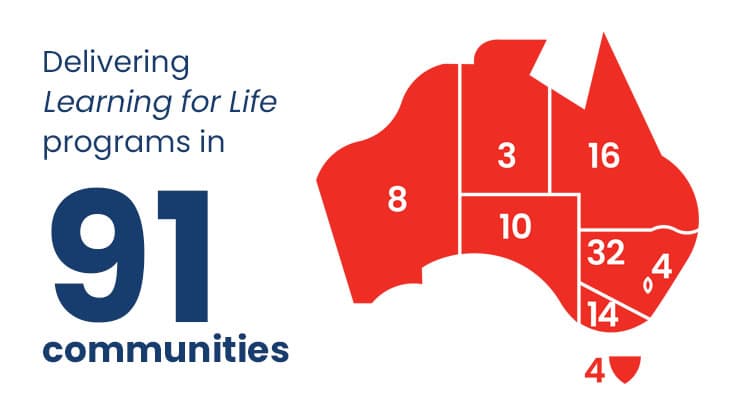
Working across Australia in 91 communities
The Smith Family delivers our Learning for Life programs across 91 Australian communities, often out of the local school.
The communities have been identified as having higher concentrations of families living in economic disadvantage and are across all Australian states and territories.
In financial year 2024-25 our programs had a big impact
-
92% of early-years professionals reported the Let's Count program improved capacity to work with parents/carers to support emergent numeracy of their children.
-
94% of community professionals reported the Let's Read program increased capacity to engage families to foster children’s literacy development.
-
90% of students who participated in our student2student reading program improved their reading.
- 79% of students who participated in the Passport program increased their understanding of what to expect at high school.
Learn more
1, 2. Scicluna, K. and Thrower, J. (2024). The Australia Institute. “Ending Child Poverty in Australia” discussion paper (p. 2).
3. Jason Clare, Minister for Education (2022). Speech for The Smith Family 100th anniversary.
4. The Smith Family (2019). “Attendance Lifts Achievement”, report (p. 9).
5. Education Endowment Foundation, “2: Targeted academic support”. educationendowmentfoundation.org.uk/support-for-schools/school-planning-support/2-targeted-academic-support
6. Australian Government, Department of Education. “Benefits of Educational Attainment”. education.gov.au/integrated-data-research/benefits-educational-attainment