Child SponsorshipDonate now

Pathways, Engagement and Transitions: The Year 12 Advantage Revisited

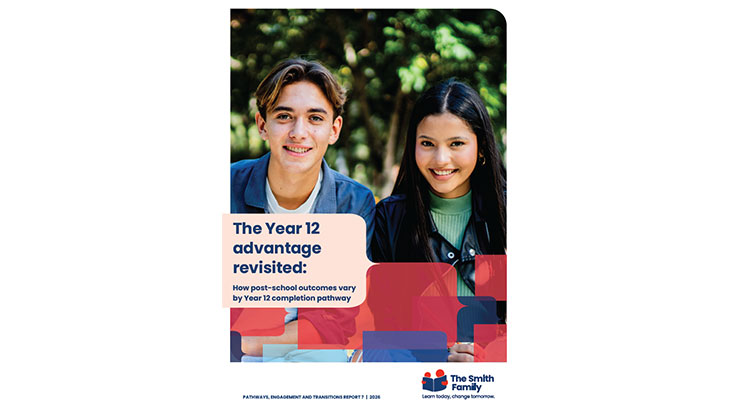
pet 7 tsf report cover
The transition from school to further education, training and employment is a critical period in young people's lives. Educational pathways are built over many years through the interaction of family resources, educational opportunities, aspirations, support systems and broader policy settings. Yet discussions about educational success often reduce these pathways to a simple distinction between completing Year 12 and leaving school early. This latest report, The Year 12 advantage: How post-secondary outcomes vary by Year 12 completion pathway, shows that Year 12 completion is not a single outcome. Rather, young people experiencing disadvantage followed four distinct pathways through senior secondary school, each associated with different patterns of engagement in education, training and employment after school.

This report, the seventh in The Smith Family's Pathways, Engagement and Transitions (PET) study, draws on six years of longitudinal data to examine the experiences of 2,070 young people experiencing disadvantage who were in Year 10 in 2020. It combines survey, interview, attendance and achievement data to explore the pathways young people took through senior secondary school, the factors associated with these pathways, and how their experiences unfolded over the four years after leaving school.

Key findings

Young people followed four distinct pathways that were associated with markedly different post-school experiences. As a result, reporting Year 12 completion as a simple binary measure may obscure important differences in educational attainment, transitions, and opportunities. 

By 2023, 68 percent of young people had completed Year 12. However, completion outcomes varied considerably:

  • 26 percent completed Year 12 and received an ATAR.
  • 32 percent completed Year 12 with a Senior Secondary Certificate of Education (SSCE) but no ATAR.
  • 10 percent completed Year 12 without receiving an SSCE.
  • 32 percent left school before the end of Year 12.

What shapes senior secondary pathways?

Pathways were shaped by a combination of individual family and educational factors. Differences were evident well before students entered secondary school.

Young people with higher Year 9 attendance and stronger academic achievement were substantially more likely to complete Year 12 with an ATAR, while those with lower attendance and achievement were more likely to leave school early. More than seven-in-ten young people with low Year 9 attendance did not complete Year 12 with either an ATAR or an SSCE.

Pathways also varied across demographic groups. ATAR attainment was more common among females, non-Indigenous students, young people whose parent/carer had completed higher levels of education, and those from non-English speaking backgrounds. These findings suggest that educational pathways are influenced not only by students’ abilities and choices, but also by the resources, opportunities, and educational experiences available to them.

The qualitative interviews reinforced this picture. Young people’s decisions reflected a combination of aspirations, interests, experiences of school, health and wellbeing, financial circumstances, access to opportunities, and perceptions of which pathways represented the best fit for their goals and circumstances.

State differences suggest system settings matter

The study identified substantial differences in pathways across states and territories. ATAR attainment ranged from around 10 percent in Western Australia to 40 percent in Victoria, while the proportion of young people completing Year 12 without an SSCE ranged from 4 percent in Victoria to 15 percent in Western Australia.

These differences suggest that outcomes are associated with young people’s characteristics and aspirations, but also with how education systems organise senior secondary qualifications and pathway options. Qualification structures, assessment arrangements, vocational pathways, and progression opportunities may all influence the pathways young people pursue and the outcomes they achieve.

Young people who complete Year 12 without a certificate warrant greater attention

Ten percent of young people remained at school until the end of Year 12, but did not receive an SSCE. Despite reaching the end of secondary school, this group’s post-school outcomes were often closer to those of early school leavers than those of students who attained a certificate.

This group also had broadly similar demographic and earlier educational characteristics to young people who attained an SSCE (but not an ATAR). The factors contributing to non-certification are therefore not readily explained by measures available in the PET study.

The findings raise important questions for future research and policy. Better understanding why some students remain engaged through to the end of Year 12 but leave school without a recognised qualification may identify opportunities for relatively targeted supports that improve certification and subsequent engagement in education, training and employment.

How were pathways associated with post-school outcomes?

Young people who achieved an ATAR consistently experienced the strongest post-school outcomes. They had the highest rates of engagement in work and study throughout the four years after school, were substantially more likely to participate in higher education, and were more likely to combine work and study.

However, the study also shows that pathways continue to evolve after school. Young people who completed Year 12 with an SSCE but no ATAR initially had outcomes closer to those of early school leavers than ATAR recipients, but their engagement improved over time. Many completed vocational qualifications, while some subsequently entered university through alternative pathways.

The interviews highlighted that pathways were often non-linear. Young people moved between work and study, entered higher education through vocational routes, and adapted their plans as circumstances changed. At the same time, barriers such as poor mental health, financial constraints, transport difficulties, caring responsibilities and low apprenticeship wages sometimes delayed or interrupted intended pathways.

Careers guidance can help young people navigate pathways

Most young people reported receiving careers advice, but access and perceived usefulness differed across pathways. Young people who left school early were less likely to receive careers advice and less likely to find it useful.

Young people described careers advice as most valuable when it started early enough to inform subject choices, considered multiple pathway options rather than focusing narrowly on university entry, and provided practical support to help translate aspirations into achievable plans.

Implications for policy and practice

The findings suggest that policy attention should move beyond a narrow focus on Year 12 completion rates. What appears to matter is not simply whether young people remain at school until Year 12, but whether they leave school with a recognised qualification and a viable pathway into further education, training or employment.

These findings point to four broad priorities:

  • Recognise the diversity of pathways. Report and monitor Year 12 outcomes beyond a simple completion/non-completion measure, distinguishing between ATAR, non-ATAR certificate and non-certificate pathways.
  • Intervene earlier. Differences in pathways are evident well before Year 12, highlighting the importance of supporting attendance, engagement and achievement throughout childhood and adolescence, not only during the secondary years.
  • Strengthen pathway planning. Ensure young people and their families understand the full range of senior secondary, vocational and post-school options available to them, supported by timely careers guidance and informed subject selection.
  • Support successful transitions. Maintain flexible pathways into education and training after school, while addressing practical barriers such as transport, costs, health concerns, and caring responsibilities that can interrupt participation.

As Australia increasingly relies on a workforce with post-school qualifications, understanding which pathways support qualification attainment and successful transitions becomes increasingly important. Improving outcomes for young people experiencing disadvantage will require attention not only to whether students stay at school, but also to the qualifications they attain, the opportunities available to them, and the support they receive when navigating their educational and employment pathways.

two girls sitting on the stairs on a laptop together