Child SponsorshipDonate now

Community attitudes survey 2026

The latest Community Attitude Survey reflects how people broadly perceive poverty in our society and what can be done to combat it.
The latest results show that the vast majority of people are aware of child poverty in the community and are keen to do something about it, with more than four in five people saying it should be a national priority.
Nearly three-quarters of respondents expect child poverty to worsen over the next 12 months, due to cost-of-living increases. Two-thirds said they had seen childhood poverty worsen over the last year.

Currently, one in six children in Australia are growing up in poverty.1 That’s 757,000 children and around 1.2 million when you also include young people between the ages of 15 to 24 – and it’s having a direct impact on their education.

The vast majority of Australians understand that poverty can impact a child’s education, with more than four in five agreeing that students experiencing disadvantage should receive extra support for their education. But the full extent of those impacts on education often remains hidden from the public eye. This is particularly the case when it comes to education, and the barriers poverty can create for students experiencing disadvantage.
This survey is one of several that The Smith Family regularly conducts to gauge community attitudes towards various issues relating to the impact of poverty on children's education. Through this survey, we aimed to gain a better understanding of public perceptions on these matters and to inform our ongoing efforts to address the challenges facing disadvantaged children and families in our communities.
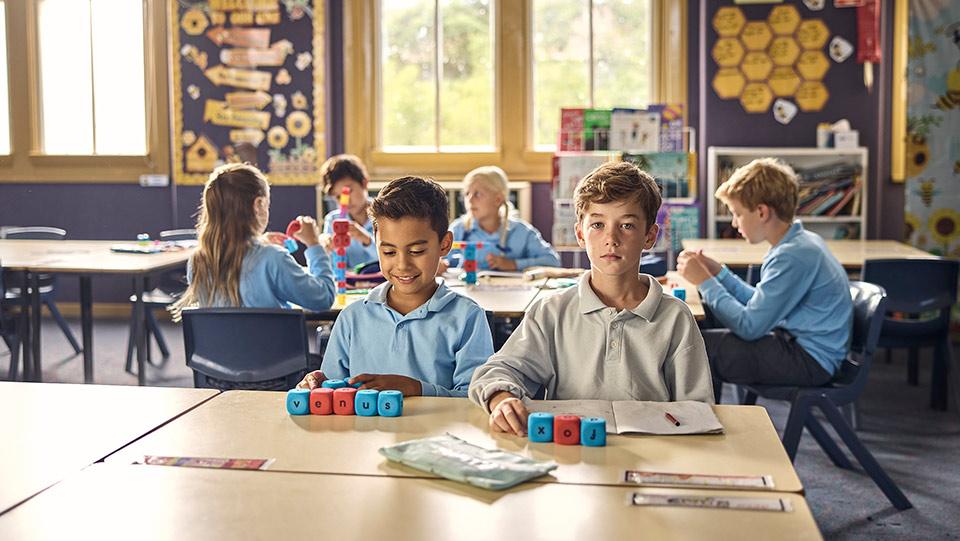
school students sitting in the classroom together

Key findings

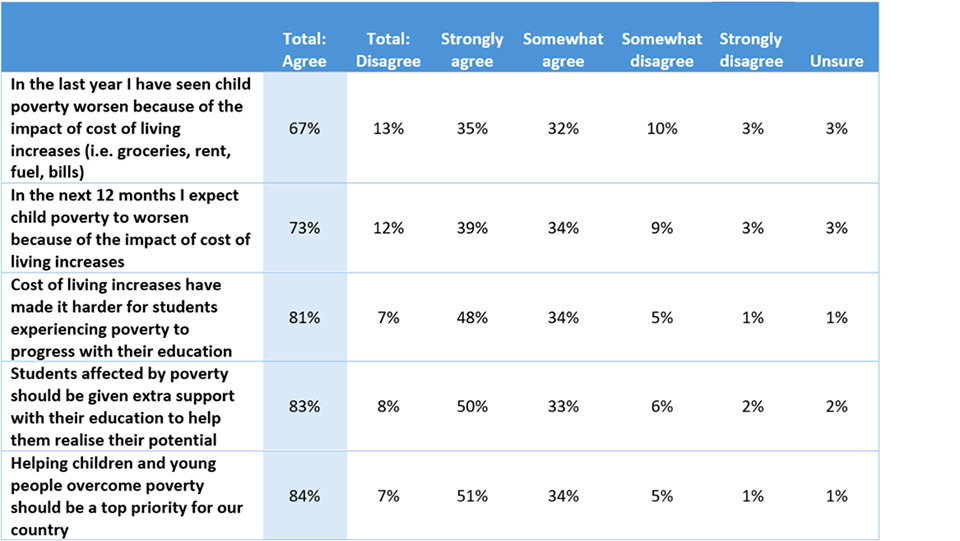
  • 84% agree that helping children and young people overcome poverty should be a top priority for Australia.
  • 83% of people say that students affected by poverty should be given extra support for their education.
  • 81% agree that cost-of-living increases have made it harder for students experiencing poverty to progress with their education.
  • 73% of respondents expect child poverty to worsen in the next year due to cost-of-living increases.
  • 77% of people agree that a computer and reliable access to the internet are now essential for any child's education, and 76% said digital skills are important for a young person’s secondary education.
  • Financially assisting with the costs of school essentials (61%) and providing them with a laptop and affordable internet access (61%) are seen as the most effective ways to help students experiencing disadvantage.

Child poverty has worsened and fixing it should be a top priority

1 in 6 young people are currently experiencing poverty. According to ACOSS, the poverty line (after taxable income) is $584 a week for a single adult and $1,226 a week for a couple with two children. With this in mind, to what extent do you agree or disagree with the following statements about students experiencing poverty in Australia?

The survey results indicate that there is an appetite for more action to help children and young people overcome poverty, with 84% of respondents agreeing that it should be a top priority for the nation. Nearly three-quarters (73%) are expecting child poverty to worsen in the next 12 months. Eight out of ten people (81%) said that cost-of-living increases had made it harder for students to progress with their education. And 83% said they believed students affected by poverty should be given extra support additional support to help them with their studies.
a blue and white numeric table with data and statistics

Effectiveness of poverty interventions

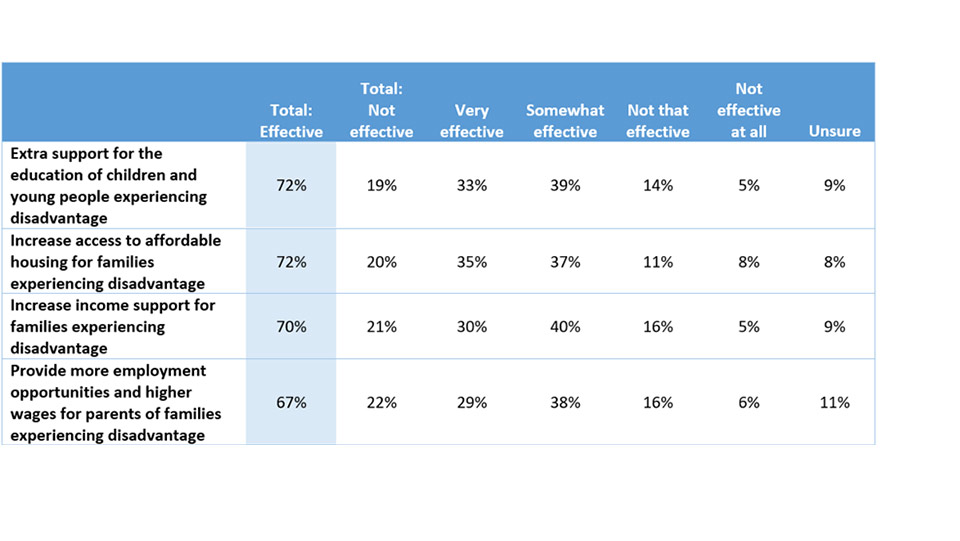
How effective do you think each of the following options are to help children and young people overcome poverty?

When asked about what actions should be taken to overcome child poverty, education and housing support were chosen as being the most effective, with 72% of respondents saying they were very or somewhat effective solutions. Seven out of ten said increased income support for families experiencing disadvantage was effective. Two-thirds (67%) nominated providing greater employment opportunities or higher wages.
a blue and white numeric table with data and statistics

Impact of poverty on education

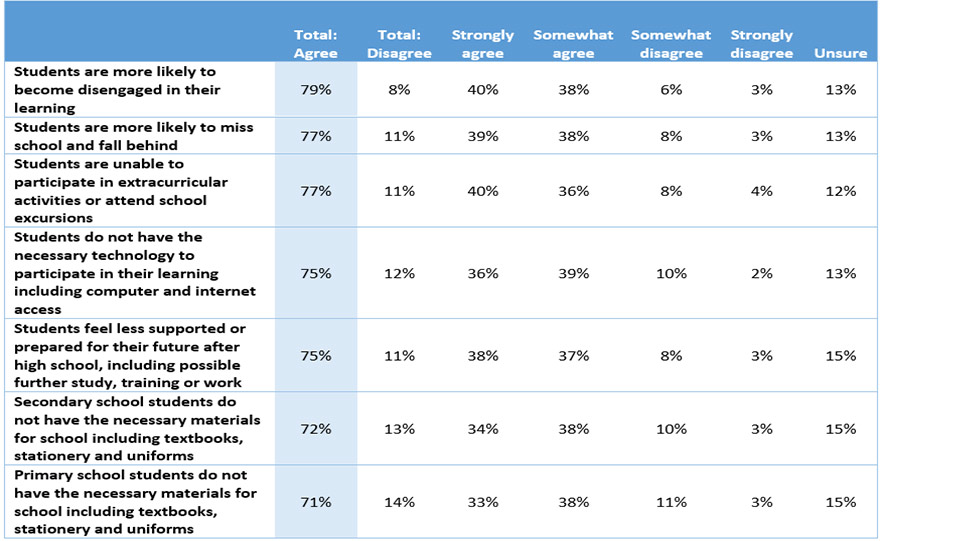
To what extent do you agree or disagree with the following statements about how poverty impacts on a student’s education?

The way poverty impacts on a student’s education can show up in a variety of ways. Over three-quarters (77%) of respondents to the survey agree that poverty means students disengage with their schooling. The same number said students were likely to miss school and fall behind.
a blue and white numeric table with data and statistics

Effectiveness of education interventions

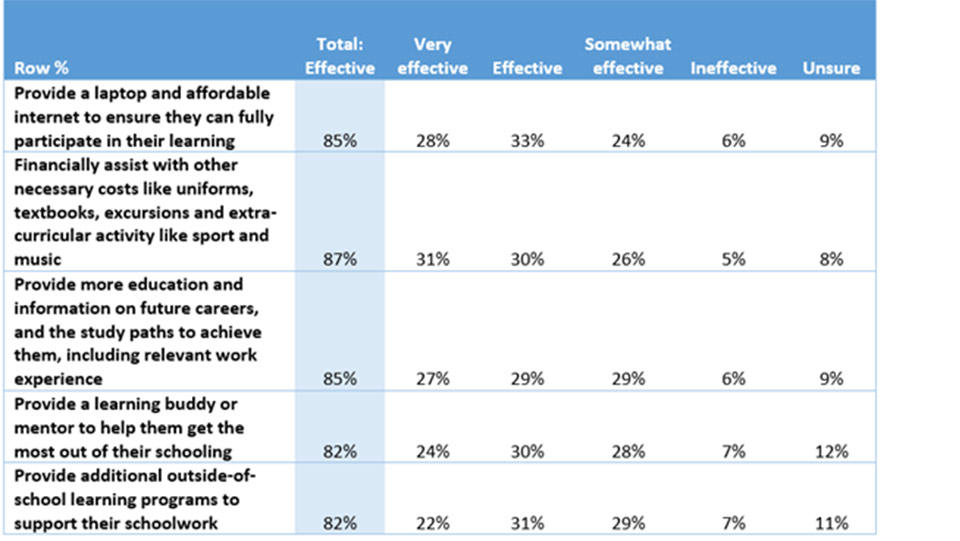
How effective do you think each of the following options are to help students who are experiencing disadvantage with their schooling?

Providing a laptop and affordable internet or helping with essential school costs (both 61%), were seen as the most effective way of supporting students experiencing disadvantage.  56% thought providing more information about careers and work would be effective. And over half of respondents nominated providing mentoring support (53%) or providing access to out-of-school learning (also 53%).
a blue and white numeric table with data and statistics

Importance of access to technology

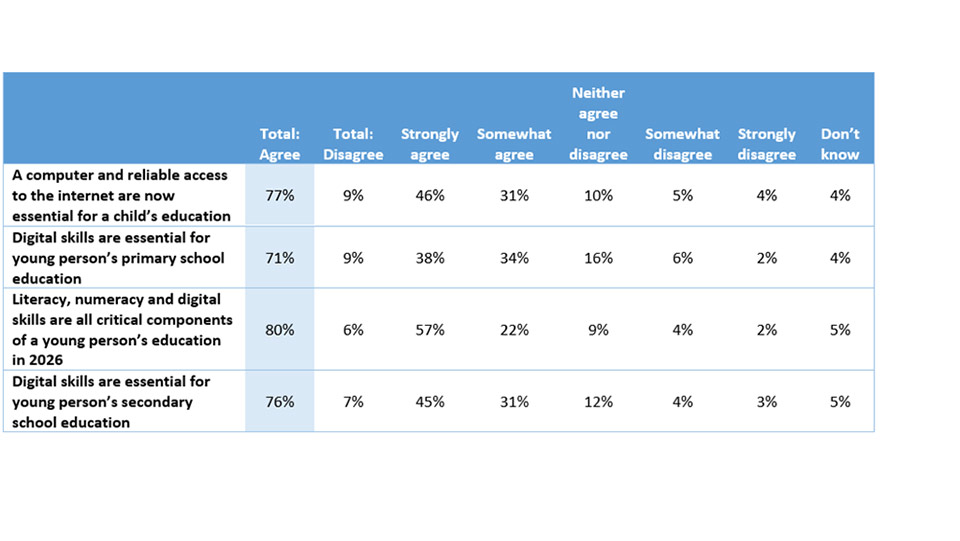
To what extent do you agree or disagree with the following statements?

Being digitally connected is now an essential part of any education. Four in five (80%) respondents agreed that literacy, numeracy and digital skills were a critical component. Over three-quarters (77%) said that having a laptop and reliable internet access was important. And slightly more people recognised that digital skills were essential for secondary school students (76%) than for primary school students (71%).
a blue and white numeric table with data and statistics

How The Smith Family helps

children in a classroom together with a smith family learning for life coordinator
The Smith Family believes in a world where every child is empowered to change their future, and education is the most powerful agent to support that change.
 
The Smith Family supports the education of children and families experiencing disadvantage by offering access to a range of proven out-of-school education and mentoring programs. These start in the early years (Let’s Count, Let’s Read) and, through the Learning for Life sponsorship program, and go right through to tertiary education and the transition into the workforce (Growing Careers Project).

Along the way, they can access reading support programs like student2student, explore the world of work through Work Inspiration, or develop their passion for the arts on the SmArts program.

Support through The Smith Family also helps families afford the necessities their children need to make the most of their education. This means that families don’t have to make a choice between paying for things like food or rent and buying the uniforms and schoolbooks that are needed for a child to thrive at school.

Financial support has become even more important as computers and digital access have become essential tools in any child’s education.

How can you get involved? You can make a donation, become a regular giver or sponsor a student on the Learning for Life program. Your generous support will help a child learn today, so they can create their own futures.
 

About the poll

a school boy using a computer

The Community Attitudes Survey summarises the results of a monthly omnibus conducted by Essential Research with data provided by QuestionPro. The survey was conducted online from 18th to 22nd February 2026 and is based on 1,002 respondents. 

The weighting efficiency applied to the results at a national level is 79%, which gives an effective sample size of 796. The maximal margin of error at this effective sample size is ±3.5% (95% confidence level). 

Note that due to rounding, not all tables necessarily total 100% and subtotals may also vary.

2025 Davidson, P & Bradbury, B (2025) Poverty in Australia 2025: Overview Australian Council of Social Service (ACOSS) and UNSW Sydney https://povertyandinequality.acoss.org.au/poverty_in_australia_2025_overview/